What is the Oldest Book in the World?A Journey Through Time
Throughout history, books have served as vessels of knowledge, preserving the thoughts and stories of generations. Ancient texts not only capture the essence of their time but also reflect the values, struggles, and triumphs of civilizations long gone. They offer us a window into the past, allowing us to understand our roots and cultural heritage. Take, for instance, the Epic of Gilgamesh, a Mesopotamian poem that dates back to around 2100 BCE, which explores themes of friendship, mortality, and the quest for meaning, issues that resonate even today.
As we delve into the world of these ancient manuscripts, a captivating question arises: what is the oldest book in the world? This inquiry ignites our curiosity, drawing us deeper into the rich tapestry of literary history. As we explore this topic, we'll not only uncover intriguing details about the oldest texts but also reflect on their enduring impact on society and culture.
Imagine holding a book that has survived millennia, its pages whispering secrets of the past. Each turn of the page reveals not just words, but the thoughts and dreams of people who lived in an era far removed from our own. What stories might these ancient authors share with us if they could? Join me on this journey as we seek to answer the question of the oldest book in the world and uncover the remarkable legacy of humanity's written word.
Defining 'Oldest Book'
To explore what qualifies as the oldest book in the world, we first need to define what we mean by "book." In its simplest form, a book is a collection of written, printed, or illustrated pages, typically bound together. However, this definition has evolved over time. Ancient texts were often inscribed on materials like clay tablets or papyrus scrolls, which may not resemble the hardcover or paperback formats we are familiar with today. For instance, the "Epic of Gilgamesh," written around 2100 BCE on clay tablets, is one of the earliest examples of literary writing. Yet, it challenges our modern conception of a “book.”
Age and format play pivotal roles in how we understand the term 'oldest.' While many might envision a leather-bound tome filled with ink and paper, others may consider the format of the text itself. Some argue that the oldest “book” could even be a scroll, like the Dead Sea Scrolls, which date back to around 300 BCE and include some of the earliest known manuscripts of biblical texts.
The debate isn't just about age but also about the significance of the content and its influence. A text that has been read and revered through centuries carries a different weight than one that is merely older in age. This makes our exploration of the oldest book not just a pursuit of age but also a quest for understanding the impact of these ancient words on humanity. So, when pondering what is the oldest book in the world, we find ourselves not just sifting through dust and ink, but also navigating a rich tapestry of history and meaning.
The Oldest Known Book: The Epic of Gilgamesh
One of the earliest contenders in our quest for what is the oldest book in the world is the Epic of Gilgamesh. This ancient Mesopotamian text dates back to around 2100 BCE, originating from the cradle of civilization in what is now modern-day Iraq. Written on clay tablets in cuneiform script, the epic chronicles the adventures of Gilgamesh, a historic king of Uruk, who embarks on a journey to discover the secret of eternal life.
The Epic of Gilgamesh stands out not only for its age but also for its profound themes that resonate through the ages. At its core, the epic tackles universal questions, what it means to be human, the inevitability of death, and the quest for friendship and legacy. For instance, Gilgamesh's relationship with his close companion, Enkidu, illustrates the transformative power of friendship. Their bond leads Gilgamesh to confront his own mortality, resulting in a poignant exploration of grief and loss.
Additionally, the story delves into the pursuit of wisdom and understanding. Gilgamesh learns that immortality is not found in physical existence but in the lasting impact one has on others and the world. This theme has echoed through countless cultures and literary works, influencing everything from Greek mythology to modern storytelling.
As we reflect on the significance of the Epic of Gilgamesh, we see that it is not merely a collection of ancient tales. Instead, it serves as a mirror reflecting our deepest fears and hopes, a testament to the human experience that remains relevant even today. In our exploration of what is the oldest book in the world, we discover that some words, despite the passage of millennia, continue to speak directly to our hearts.
Other Contenders for the Title
While the Epic of Gilgamesh often takes the spotlight in discussions about what is the oldest book in the world, several other ancient texts deserve our attention for their remarkable historical significance and literary contributions.
One such contender is the Diamond Sutra, a groundbreaking Buddhist text that dates back to 868 CE. This scroll, originating from China, is recognized as the world's oldest dated printed book. Its teachings on the nature of reality and the concept of emptiness have influenced countless readers and practitioners over the centuries. The Diamond Sutra, with its elegant woodblock printing, not only marked a technological advancement in book production but also served as a bridge connecting spiritual insight with everyday life.
On the other side of the world, we find the Book of Kells, created around the year 800 CE on the Emerald Isle of Ireland. This illuminated manuscript is a visual feast, showcasing intricate artwork and vibrant colors that bring biblical texts to life. The Book of Kells is not just a religious artifact; it reflects the deep cultural heritage of Ireland, encapsulating the artistic spirit of a time when monks dedicated their lives to preserving knowledge through art.
When we compare these texts, we see that while the Diamond Sutra emphasizes philosophical teachings, the Book of Kells highlights the interplay between faith and artistry. Each text, rooted in its unique historical context, contributes to our understanding of literature and the written word.
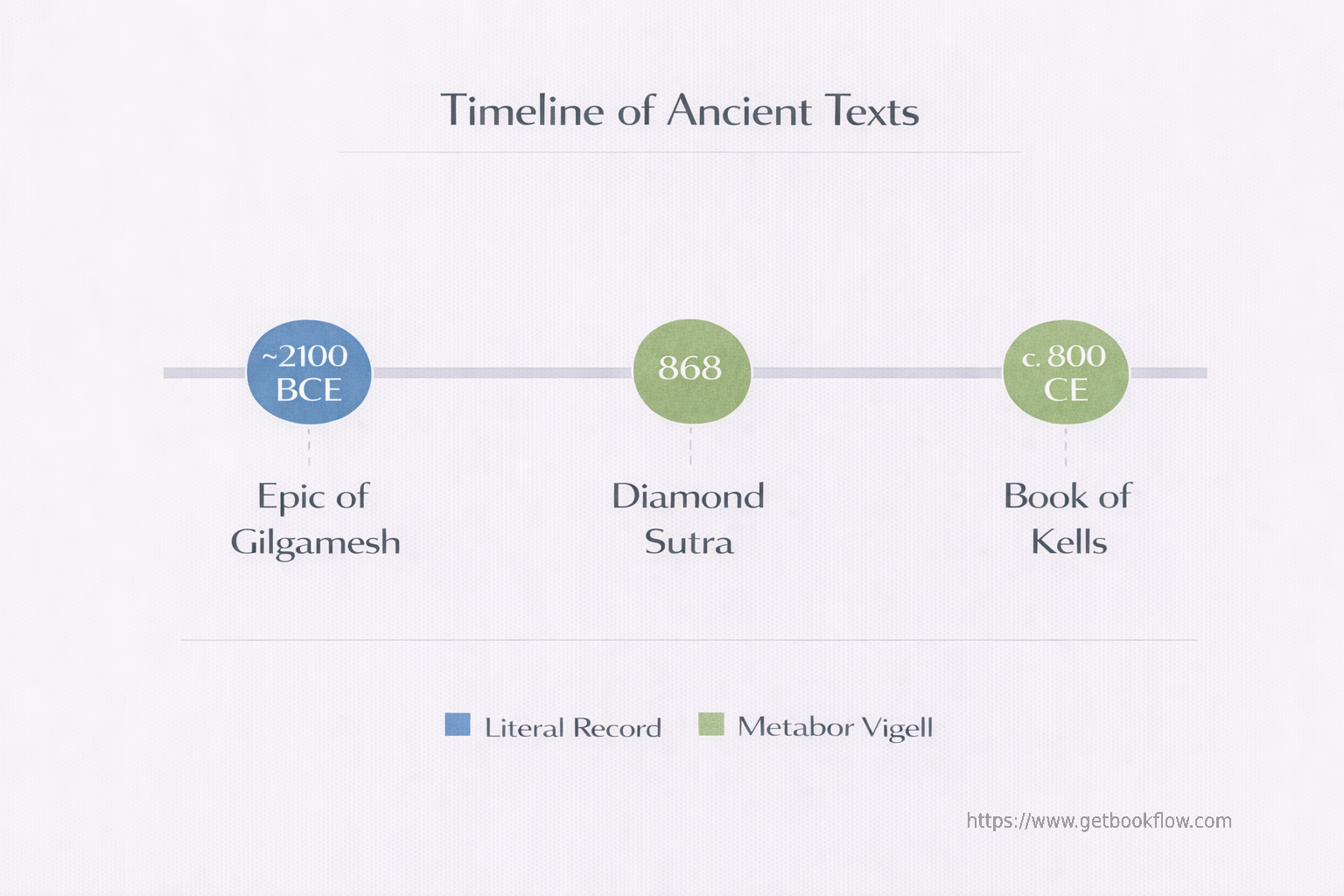
In tracing a timeline of ancient texts, we see the Epic of Gilgamesh from around 2100 BCE, the Diamond Sutra from 868 CE, and the Book of Kells from circa 800 CE. This timeline reveals not just the age of these works but also the evolution of human thought and creativity across cultures and eras. Each of these texts serves as a testament to our enduring quest for understanding, knowledge, and beauty in the written word.
The Importance of Ancient Texts
Ancient texts are like time capsules, offering us glimpses into the thoughts, beliefs, and daily lives of people who lived centuries or even millennia ago. They help us understand how societies evolved, how cultures intertwined, and how human experiences: love, loss, triumph, and despair, remain remarkably consistent across time. When we ponder what is the oldest book in the world, we’re not just asking about a physical artifact; we’re exploring the essence of humanity itself.
Take, for instance, the Epic of Gilgamesh. This ancient Mesopotamian poem, regarded as one of the earliest literary works, delves into themes of friendship, mortality, and the search for meaning, issues that resonate profoundly even today. When I first encountered this epic, I was struck by how little human nature has changed despite the passage of thousands of years. It reminded me of conversations I've had with friends about our own fears and aspirations, showcasing that the core of our existence remains similar.
Moreover, consider the philosophical insights found in texts like the Tao Te Ching, written around the 6th century BCE. Its teachings on harmony and balance can be applied to our modern lives, serving as a reminder to slow down and reflect amidst the chaos of daily routines.
By engaging with these ancient works, we not only gain knowledge but also form a bridge connecting us to those who came before us. Each text is a thread in the vast tapestry of human history, weaving together stories that still hold relevance today.
Conclusion
In conclusion, exploring the question of what is the oldest book in the world takes us on a fascinating journey through time and culture. Whether it’s the Epic of Gilgamesh, with its profound reflections on friendship and mortality, or the Tao Te Ching, offering wisdom on balance and harmony, these ancient texts serve as windows into the thoughts and beliefs of civilizations long past. They remind us of our shared humanity and the challenges that transcend eras, such as the quest for understanding, connection, and meaning.
As we uncover these timeless narratives, we invite you to delve deeper into the world of ancient literature. Imagine sitting by a fire, thousands of years ago, listening to stories that resonate even today. Each page you turn isn’t just a glimpse into history; it’s a chance to reflect on our own lives and the wisdom we can draw from those who lived before us.
So, go ahead and pick up an ancient text, whether it’s the Iliad, the Bhagavad Gita, or even the Pyramid Texts. Explore how their insights can enrich your daily life, foster personal growth, and help you navigate the complexities of modern society. These books are more than artifacts; they are companions on our journey, offering guidance and perspective in an ever-changing world. Let’s honor our shared legacy by engaging with these remarkable works and discovering the timeless lessons they hold.