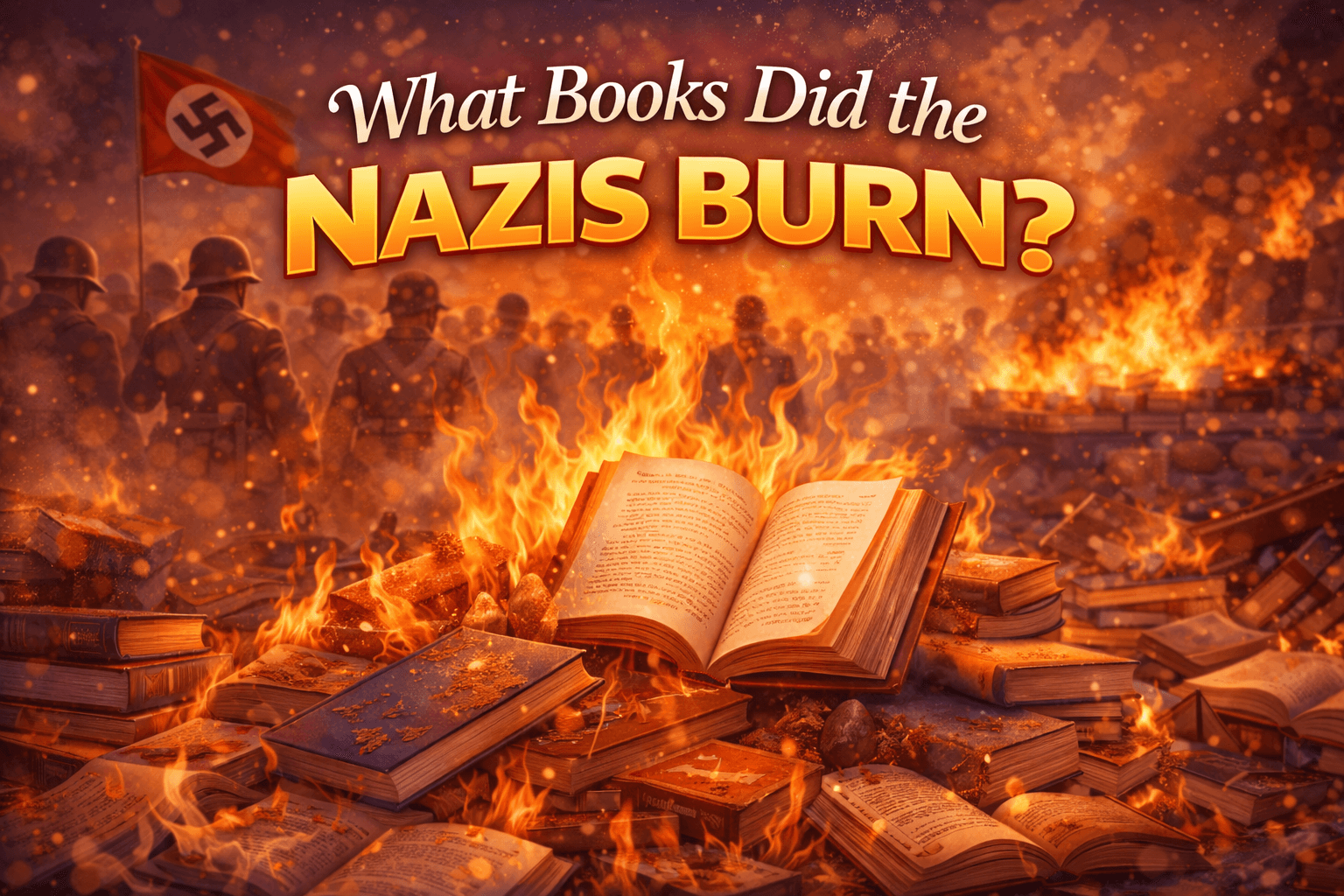
A Thoughtful Look at the 1933 Book Burnings
In May 1933, just months after Adolf Hitler became Chancellor, Nazi-aligned university students organized public book burnings across Germany. On May 10, the most famous event took place in Berlin's Opernplatz (now Bebelplatz), where tens of thousands gathered to watch over 20,000–25,000 books consigned to flames amid speeches, music, and ceremonial "fire oaths." Similar burnings occurred in more than 20 university towns.
These events were not random. They formed part of the Nazis' campaign to align German culture with their ideology (Gleichschaltung), purging what they labeled "un-German" ("undeutsch") literature. The burnings targeted books by Jewish authors, pacifists, leftists, communists, socialists, and anyone deemed subversive or morally corrupting.
This act of cultural destruction foreshadowed greater horrors to come. As Heinrich Heine warned in 1820, "Where they burn books, they will ultimately burn people as well." That prophecy proved tragically accurate.
This guide draws from verified historical records, including the United States Holocaust Memorial Museum's Holocaust Encyclopedia, Wikipedia's well-sourced overview, and contemporary reports. We explore what was burned, who was targeted, and the human cost of this assault on ideas.
The Scope of the Burnings
The Nazi student union (Deutsche Studentenschaft) orchestrated the May 10, 1933, burnings as a nationwide spectacle. Students raided libraries, bookstores, and private collections, gathering books from "blacklists" compiled by Nazi librarian Wolfgang Herrmann. These lists categorized works as "un-German" by genre, author, and ideology.
Estimates vary, but Berlin alone saw 20,000–25,000 books burned. Across Germany, the total reached tens of thousands more. Additional burnings continued throughout 1933 and in occupied territories later.
The events were broadcast on radio, with Joseph Goebbels delivering a fiery speech in Berlin: "The era of extreme Jewish intellectualism is now at an end."
Who Was Targeted? Authors and Ideas the Nazis Feared
The Nazis burned books by:
Jewish authors (regardless of content)
Pacifists (anti-war writers)
Leftists, communists, socialists
Foreign authors seen as decadent or subversive
Any work promoting liberal, democratic, or "degenerate" ideas
Prominent names repeatedly mentioned in fire oaths and blacklists include:
Erich Maria Remarque - author of All Quiet on the Western Front, a powerful anti-war novel. His book was vilified as a betrayal of German soldiers.
Sigmund Freud - the founder of psychoanalysis, targeted as a Jewish intellectual.
Albert Einstein - the physicist's works were burned for his Jewish heritage and pacifism.
Thomas Mann and Heinrich Mann - Nobel Prize winner Thomas and his brother, both critics of Nazism.
Bertolt Brecht - playwright and poet, known for leftist views.
Stefan Zweig - Austrian Jewish author of humanistic literature.
Karl Marx and Friedrich Engels - foundational communist thinkers.
Rosa Luxemburg and Karl Liebknecht - prominent socialists.
Helen Keller - American author and activist, burned for her social justice writings.
Ernest Hemingway - American novelist, targeted for perceived decadence.
Magnus Hirschfeld - sexologist whose institute's library was looted and burned in Berlin.
Other notable targets included Lion Feuchtwanger, Kurt Tucholsky, Franz Kafka, Heinrich Heine, Walter Benjamin, Joseph Roth, Anna Seghers, Erich Kästner, and Carl von Ossietzky.
The lists were broad: from philosophy and science to fiction, poetry, and children's books. Anything challenging Nazi ideology, democracy, pacifism, modernism, or Jewish thought was condemned.
The Human Cost: Censorship and Exile
The book burnings were symbolic but had real consequences. Authors were blacklisted, banned from publishing, and many fled into exile. Some, like Carl von Ossietzky, were imprisoned. Others, including Stefan Zweig, later took their own lives amid despair.
The burnings marked the start of systematic cultural suppression. Libraries were purged, publishers censored, and intellectual life stifled.
A Reflection on the Power of Ideas
The Nazis burned books to silence ideas they feared. Yet ideas are not so easily destroyed. Many banned authors' works survived through exile, underground circulation, and postwar rediscovery. Today, their voices continue to speak against tyranny.
The events remind us how fragile freedom of thought can be and how precious it is to protect.