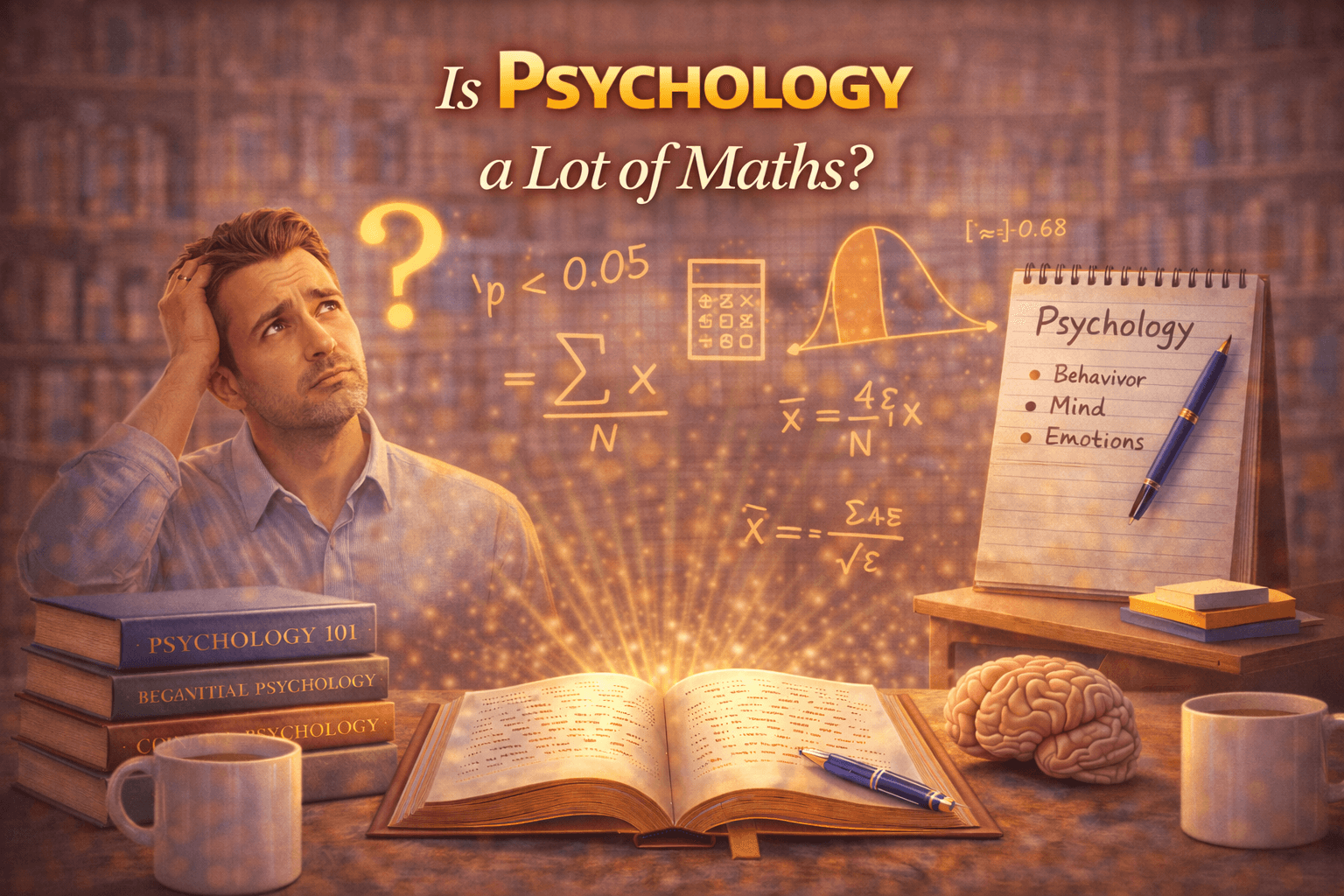
When people think of psychology, many envision a field filled with deep conversations, emotional insights, and the mysteries of the human mind. However, a common question that pops up is, “Is Psychology a lot of maths?” This query often stems from the belief that to understand human behavior, one must dive into the realm of numbers and equations. It’s a fair concern, especially considering that psychology is a science that seeks to unravel the complexities of our thoughts and actions.
At the heart of psychological research lies the crucial role of statistics. These mathematical tools allow researchers to analyze data, draw meaningful conclusions, and ultimately understand patterns in behavior. For example, if a psychologist wants to study the effects of sleep on academic performance, they might collect data from hundreds of students. By using statistical methods, they can determine if there’s a significant relationship between the amount of sleep students get and their grades.
Statistics also help psychologists validate their theories. A classic example is the famous Stanford prison experiment, where researchers used quantitative measures to assess how individuals would conform to roles in a simulated prison environment. The data collected from this study provided valuable insights into human behavior but also highlighted the importance of robust statistical methods to interpret findings accurately.
So, while it’s true that psychology involves some level of mathematics, it’s not all about crunching numbers. Instead, statistics serve as a bridge to deeper understanding, allowing us to make sense of the fascinating narratives behind human actions.
The Role of Mathematics in Psychology
In exploring whether psychology involves a lot of maths, it's important to recognize the various areas where mathematics plays a vital role. One prominent area is research design, where psychologists use mathematical principles to structure experiments and surveys. For instance, when measuring the effectiveness of a new therapy, researchers often employ statistical techniques to ensure their findings are valid and reliable.
Statistics also helps psychologists make sense of complex data. Consider a study on the effects of sleep deprivation on mood. By analyzing the numerical data collected from participants, psychologists can reveal patterns and correlations that might not be immediately apparent. For example, they might find that individuals who sleep less than six hours a night report a significantly higher incidence of anxiety, perhaps 60% more than those who sleep eight hours.
Moreover, some branches of psychology, such as cognitive and developmental psychology, frequently rely on mathematical models to simulate behavior or understand cognitive processes. These models can predict how people learn or make decisions based on various stimuli, providing a structured way to interpret human behavior.
So, while the question of whether psychology is a lot of maths may lead some to think of endless equations and formulas, it's really about using mathematics as a tool. It helps illuminate the intricate tapestry of human experience, enabling us to draw meaningful conclusions from our observations and studies. Ultimately, the integration of math and psychology enriches our understanding of the human mind in profound ways.
Statistics: The Backbone of Psychological Research
In the realm of psychology, statistics play a pivotal role in transforming raw data into meaningful insights. Statistical methods are used to analyze data collected from experiments, surveys, and observational studies, allowing psychologists to draw conclusions about human behavior and mental processes. This is where the question, "Is psychology a lot of maths?" becomes particularly relevant. While it may not seem obvious at first glance, a strong foundation in statistics is essential for psychologists looking to make sense of their findings.
For example, consider a study investigating the effects of sleep on cognitive performance. Researchers might collect data from two groups, one that gets a full night's sleep and another that is sleep-deprived. By employing statistical techniques such as t-tests or ANOVA, the researchers can determine whether the differences in performance are statistically significant, ultimately providing valuable insights into how sleep impacts our cognitive functions.
Another notable example is the use of regression analysis to understand the relationship between stress levels and academic performance among college students. This study might reveal that higher stress levels correlate with lower grades, providing evidence that can inform counseling practices and student support services.
To put the reliance on statistics into perspective, a survey of psychology researchers found that over 80% reported using statistical software in their studies. This reliance showcases how essential it is for psychologists to be comfortable with numbers. Whether it’s understanding correlations, measuring effects, or predicting outcomes, statistics serves as the backbone of psychological research, helping us understand the complexities of the human mind.
Do You Need to Be Good at Maths to Study Psychology?
When considering the question, "Is Psychology a lot of maths?" it's essential to understand the level of mathematical proficiency required to study this fascinating field. While it's true that psychology does incorporate statistics and research methods, you don’t need to be a math whiz to succeed.
Many psychology programs will introduce you to the necessary mathematical concepts without expecting you to have a strong background in the subject. Most schools require only a basic understanding of algebra and some familiarity with statistical concepts. For instance, you might encounter descriptive statistics, which simply summarize data, or inferential statistics, which help make predictions or generalizations about a population based on your sample.
If you are someone who feels uneasy about math, remember that many students feel the same way at first. The key is to approach these challenges with an open mind and a willingness to learn. With the right mindset and support, you can navigate the mathematical aspects of psychology just fine.
Conclusion
In conclusion, while the question "Is Psychology a lot of maths" might initially evoke a sense of dread for many, it’s essential to recognize the significant role mathematics plays in this fascinating field. Understanding statistics and data analysis is not just a requirement; it is a powerful tool that helps us gain deeper insights into human behavior. For instance, when researchers use statistical methods to analyze survey data, they can uncover trends and correlations that inform our understanding of mental health and societal dynamics.
Take, for example, the way psychologists study the effectiveness of different therapies. By employing statistical tests, they can determine whether a new treatment truly benefits patients or if the observed improvements are merely due to chance. This application of math is crucial in ensuring that the conclusions drawn are reliable and meaningful.
Embracing the statistical aspects of psychology can open new doors. Consider the journey of many students, like the one mentioned earlier, who transition from apprehension to enjoyment in their coursework. With supportive peers and a mindset geared towards growth, tackling these mathematical challenges becomes an opportunity for personal and professional development.
So, if you find yourself feeling anxious about the math involved in psychology, know that you are not alone. With curiosity and perseverance, you can master these concepts and appreciate the depth they add to our understanding of the human mind. The journey may be daunting, but the rewards are well worth the effort.